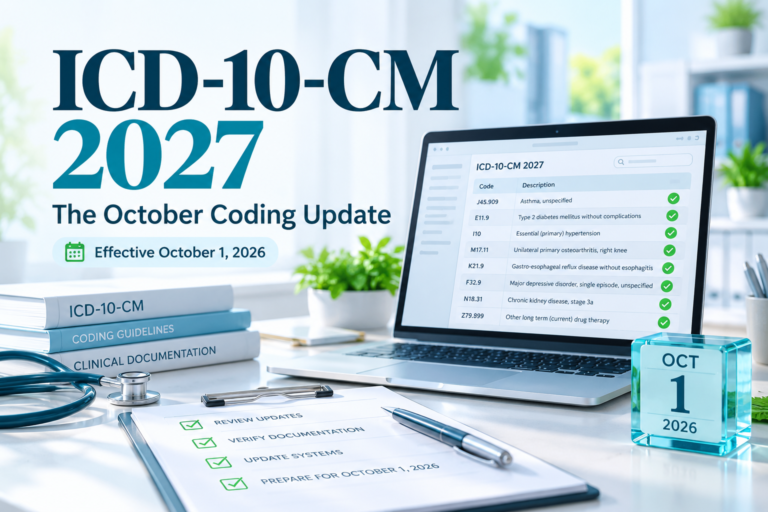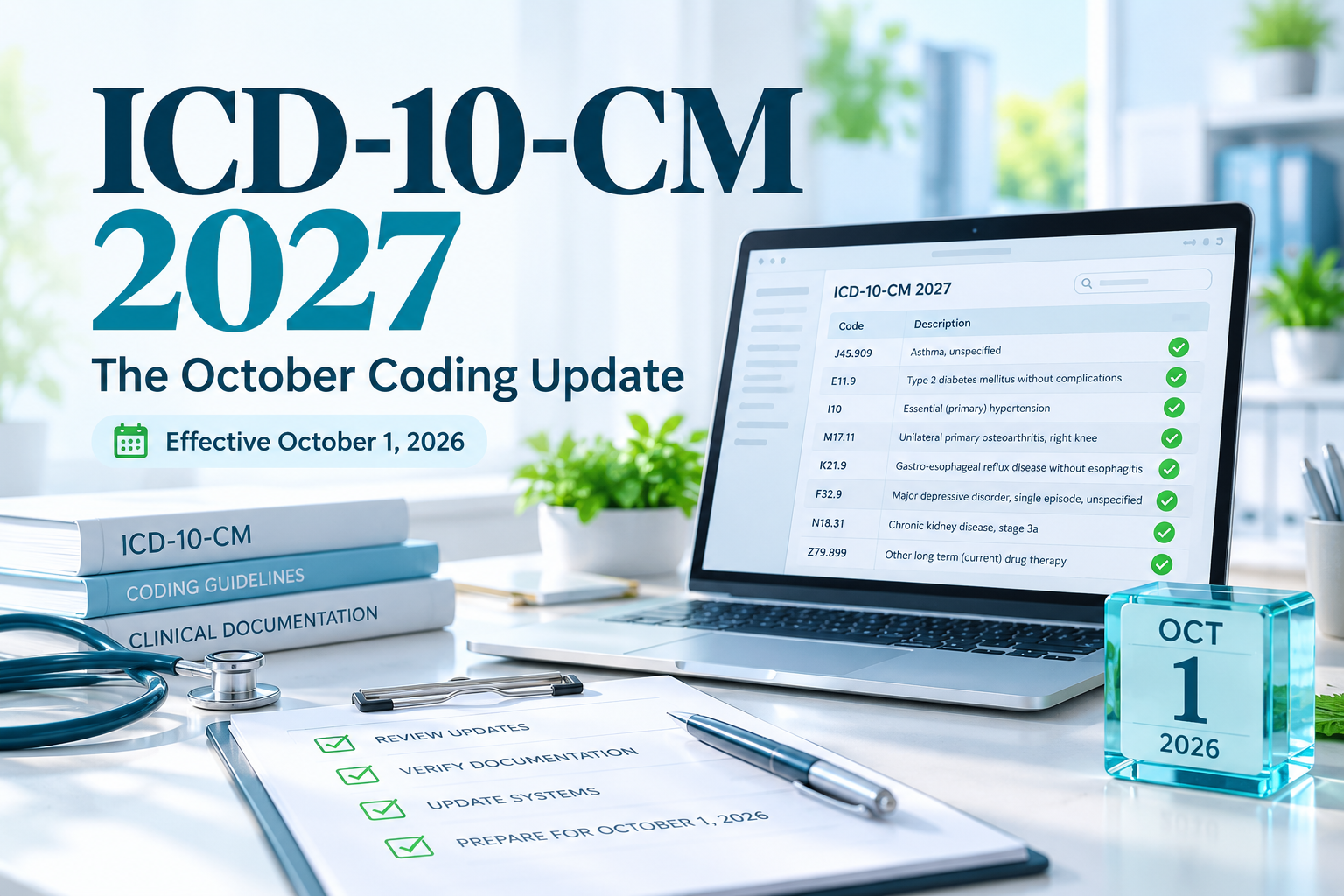
Quick answer: The ICD-10-CM 2027 updates took effect on October 1, 2026. Use the FY 2027 diagnosis code set for patient encounters and applicable inpatient discharges from October 1, 2026, through September 30, 2027. Update your coding software, review the official addenda, and verify documentation before releasing claims. The date you submit a claim does not, by itself, determine its code-set year.
October brings a practical challenge for medical practices: yesterday’s diagnosis favorites may need review, while older encounters still require their historical code set. A software update alone cannot resolve missing documentation or an incorrect coding decision. This guide explains how to implement the new release and build a defensible review process.
Source check: October 6, 2026. This is an implementation guide based on CMS and CDC publications, rather than an exhaustive list of every new or revised code.
When do the ICD-10-CM 2027 updates apply?
The fiscal year begins before the calendar year: FY 2027 starts October 1, 2026. CMS identifies the applicable period as October 1, 2026, through September 30, 2027, for patient encounters and discharges covered by this release. CDC also identifies the October release as replacing the April 1, 2026, FY 2026 release.
For an outpatient encounter, check the service date. For an inpatient institutional claim, apply the discharge-based code-set rule. Do not assume an inpatient admission date determines the applicable release. Keep historical code sets available when correcting or resubmitting older claims.
- Outpatient visit on September 30, 2026: Use the applicable FY 2026 release, even if the claim is submitted in October.
- Outpatient visit on October 1, 2026: Use the applicable FY 2027 release.
- Inpatient institutional stay ending October 2, 2026: Use FY 2027 for the discharge, including when admission occurred in September.
Confirm the rules for the particular claim type and setting. Professional services associated with a hospital stay should not automatically inherit the institutional discharge-date logic.
Reference: CMS ICD-10 code files and effective dates.
What should you review in the October release?
Use the official FY 2027 package as your starting point. Review the addenda for additions, deletions, and revisions relevant to your specialty; consult the updated Alphabetic Index, Tabular List, and Official Guidelines for Coding and Reporting. A summary article or vendor alert can help prioritize work, but it cannot replace verification in the classification.
Build a short change log for your practice. For each affected diagnosis, record the old selection, the current valid option or options, the required documentation, the affected template or workflow, and the person responsible for checking it. Where a code requires more detail, a one-to-one replacement may not be appropriate.
The official guidelines distinguish revised material through formatting. Read changes in context, including classification instructions. The documentation and outpatient rules discussed below are continuing requirements; they should not be mistaken for newly introduced FY 2027 rules.
Keep code systems separate: ICD-10-CM classifies diagnoses. ICD-10-PCS classifies inpatient hospital procedures. An ICD-10-CM update does not replace a separate CPT, HCPCS, or ICD-10-PCS review.
A six-step ICD-10-CM 2027 implementation checklist
1. Confirm the release in every connected system
Check the EHR, practice management system, encoder, charge capture tools, and clearinghouse workflow. Ask the vendor which release is installed and how the system selects historical versions. Test a September encounter and an October encounter rather than relying only on a successful installation message.
2. Review favorites, templates, and diagnosis mappings
Check the diagnoses your specialty uses most often against the official addenda. Review saved favorites, order sets, encounter templates, and automated mappings. Retire obsolete choices for new encounters while preserving historical records. Assign a reviewer to ambiguous mappings instead of letting a replacement code silently become the default.
3. Turn documentation gaps into focused provider education
Explain which clinical details a valid selection requires. Depending on the diagnosis, those details may include laterality, anatomical site, acuity, an associated condition, or the encounter phase. Use a short, relevant example from your specialty. If the record is unclear, follow a compliant clarification process; do not invent a finding to make a code fit.
4. Verify the full code and its instructions
Locate the documented diagnosis in the Alphabetic Index, then verify the complete selection in the Tabular List. Review instructional notes, including sequencing requirements, exclusions, and any required additional code. Check laterality and applicable seventh characters. A familiar label in a favorites list is insufficient evidence that the complete code is appropriate.
See the FY 2027 Official Guidelines, Section I.B.1, for the Index-and-Tabular verification process.
5. Test representative claims before expanding the workflow
Select a small sample across your high-volume diagnoses, affected templates, and major payers. Check the service or discharge date, diagnosis selection, documentation support, and transmitted claim data. Include a historical correction. Record the actual response so your team can distinguish a software problem from a documentation issue.
6. Monitor the first weeks and close the feedback loop
Track diagnosis-related rejections, payer denials, clarification requests, and corrected claims. Assign each issue an owner and a resolution date. Share recurring findings with providers and billing staff, then update the relevant workflow. Comparing equivalent periods and using consistent definitions makes your review more useful than counting every problem as an “ICD-10 denial.”

Documentation rules that protect coding accuracy
Outpatient uncertainty is not a confirmed diagnosis
Under Section IV.H of the official guidelines, outpatient diagnoses documented as probable, suspected, questionable, or rule out are not coded as established conditions. Code to the highest degree of certainty for that encounter, such as the supported symptoms, signs, abnormal findings, or other reason for the visit.
Inpatient uncertain-diagnosis guidance is different and setting-specific. Do not transfer it to office visits or other outpatient encounters.
Unspecified codes can be appropriate
Section I.B.18 explains that symptom and unspecified codes have legitimate uses. Report the specificity the record supports. An unspecified code can accurately describe what is known at the encounter; a more detailed code without supporting documentation does not improve accuracy. Do not recommend unnecessary testing simply to obtain a more specific code.
Human review still matters with AI-assisted coding
If your team uses AI-assisted suggestions, add the release year and care setting to its review process. Ask the reviewer to confirm the suggestion against the documentation, the current classification, and applicable guidelines. A fluent explanation is not evidence that a code exists or that the record supports it.
A practical control is to record the suggested selection, the verified final selection, and why the reviewer changed it. Use those findings to improve templates and training. This is a recommended quality workflow, not a claim that CMS mandates a particular AI tool or process.
Rejection, denial, or documentation problem?
An upstream rejection means a claim may need correction before acceptance for adjudication. A payer denial is an adjudicated response. A documentation gap can contribute to either problem but requires its own review. Read the actual response and identify the root cause before changing the diagnosis.
For example, a hypothetical October office visit could be rejected because the submitted diagnosis is not valid for the service date. First verify the applicable release and the transmitted code. If the replacement requires a detail absent from the record, resolve that documentation question before resubmitting. If the code is valid but the payer denies coverage, investigate the relevant policy and appeal requirements rather than selecting an unsupported diagnosis.
Practices that need help assessing these workflows can explore MedStats Billing’s medical billing and coding services and medical billing audit services.
Frequently asked questions
What is the effective date for ICD-10-CM 2027?
The FY 2027 ICD-10-CM release became effective October 1, 2026. CMS lists its use for applicable patient encounters and discharges through September 30, 2027. Check for any subsequent official update affecting your service period.
Does an October claim submission require FY 2027 codes?
Not automatically. The applicable encounter or discharge date determines the release, rather than the submission date alone. A September outpatient visit submitted in October still uses its applicable historical code set.
Where can I find the official new and revised codes?
Use the CDC ICD-10-CM files and CMS ICD-10 resources. Review the FY 2027 addenda, Index, Tabular List, and official guidelines. Verify the complete code before relying on a summary or mapping.
Are unspecified diagnosis codes always incorrect?
No. The official guidelines permit unspecified codes when they accurately reflect the available information. Use greater specificity when supported by the record, without inferring undocumented clinical details.
Does updating the EHR guarantee payment?
No. A current code set is one part of claim accuracy. Documentation, medical necessity, coverage, eligibility, authorization, and other applicable requirements also affect reimbursement.
Official sources and practical next steps
- CMS: ICD-10 code files and implementation periods — verify the applicable code-set dates and available resources.
- CDC: ICD-10-CM files — access the official release and addenda.
- FY 2027 ICD-10-CM Official Guidelines for Coding and Reporting — see Sections I.B.1, I.B.18, and IV.H for the rules discussed above.
Start with the diagnoses and templates your team uses daily. Confirm the release, review affected documentation, test representative claims, and resolve the issues your first weeks reveal. To discuss support for your practice’s coding and claim review process, contact MedStats Billing.
This educational implementation guide does not replace the official classification, complete coding guidelines, or the policies applicable to a particular claim.